
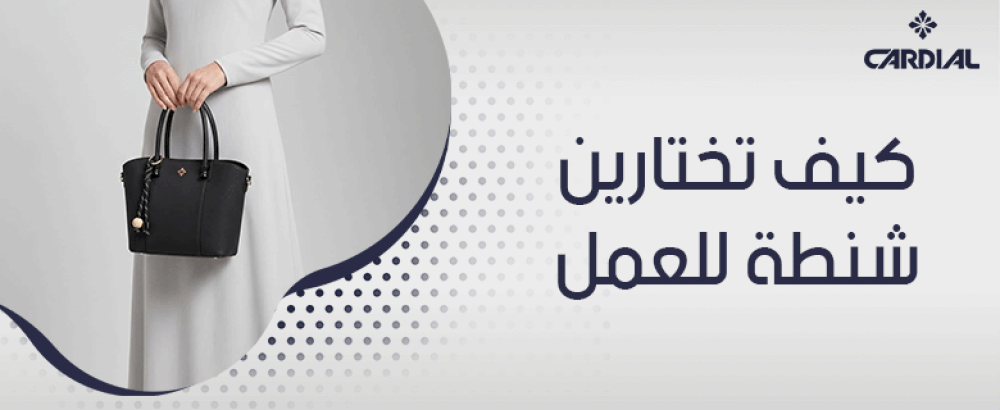
Many women buy a bag that looks beautiful and suitable in a store, only to discover after a week of use that it doesn't fit their laptop, files, or everyday items, or that carrying it for long hours becomes a burden on their shoulders and back. This highlights the need to know how to carefully choose a work bag, rather than relying solely on appearance.
Choosing the right women's work bag starts with checking the internal capacity and comparing it to what you actually carry, then moving on to the quality of the materials and the internal organization, and finally to the comfort of carrying and the weight of the bag when empty. This guide explains these points step by step, helping you distinguish between a practical work bag suitable for daily commuting and a bag appropriate for the office that suits your work environment and the nature of your tasks, before exploring the various options available for women's bags.
How do you choose a bag for work?
Choosing the right work bag starts with understanding what you actually carry every day, then matching that to the bag's actual internal dimensions, rather than relying on general descriptions like "spacious" or "large." This is what makes a bag truly practical, not just a stylish accessory.
Before buying, make a realistic list of what you will be carrying on a workday:
- Phone and wallet: essential items that are never missing from any bag.
- Keys: You need a dedicated pocket that is easily accessible.
- Notebooks, papers, or files: require sufficient flat space inside the bag.
- The charger: It is preferable to have a small pocket for it to avoid tangling the cables.
- Water bottle: You need a side pocket or separate compartment.
- Personal care items: small items that should ideally have their own pocket.
- Tablet or laptop computer as needed: Specifies the type and size of the required room.
After compiling this list, consider your work, commuting needs, and budget when choosing a bag. Determine whether the bag will be used only in the office or for frequent daily commutes, and whether it needs to accommodate documents or electronic devices regularly.
Matching the bag dimensions to the requirements
Compare the actual items you've identified to the bag's internal dimensions, not to general descriptions like "large" or "spacious." External dimensions don't always reveal the usable space, and internal dividers and pockets can reduce the actual practical capacity.
When choosing a laptop bag, first measure your device and check the dimensions of the internal compartment, if specified. Allow sufficient space for inserting and removing the laptop, as well as for cables and accompanying documents. Don't assume a padded compartment or that the bag will fit a specific laptop without confirmed specifications. Generally, choose a practical work bag with enough space to meet your daily needs, along with a little extra room. A work bag that's larger than you actually need might encourage you to carry unnecessary items and increase your carrying weight unnecessarily.
What are the specifications of a practical work bag?
The specifications of a practical work bag are determined by three basic elements: the material and its care requirements, the organization of the pockets and the method of closure, and the suitability of the design to the nature of work clothes and daily commuting.
Proper material and care
Choosing the material for a work bag is a matter of weighing up appearance, care, and usability, not a definitive judgment of quality. Leather may give a formal work bag a sophisticated look, but its weight and care requirements vary depending on its type, thickness, and manufacturing process.
Some of you might prefer faux leather for a leather work bag because of its appearance or ease of care, but its resistance to peeling or cracking isn't guaranteed simply by the material's name. Nylon or canvas materials might suit those seeking lightness and flexibility in a shoulder bag for the office, while water resistance and durability depend on the type of fabric, its treatment, and manufacturing.
- Genuine leather: It gives a formal look but requires care that varies depending on its type and thickness.
- Artificial leather: a practical option in terms of appearance and care, without a firm guarantee of resistance to peeling.
- Nylon and fabric: suitable for those looking for lightness and flexibility in daily commuting.
- Water resistance and durability: These are related to the type of fabric and industrial treatment, not just the name of the material.
Do not describe a bag as waterproof or scratch-resistant, and do not attribute to it a lifespan or guaranteed durability, unless explicit and reliable specifications are available.
Pockets, closures, and content organization
Organizing the contents of a practical bag with internal pockets depends on the number of pockets, dividers, and closure method, as well as how you arrange your belongings and how easily you can access them. Don't assume there's a dedicated laptop compartment, padded lining, or a specific type of closure unless the product specifications clearly state it.
- The number of pockets and dividers determines how easy it is to organize personal and office items.
- Closing method: varies between zipper, magnet and buttons, and affects the speed of access to contents.
- Manufacturing details: Check the stitching, cut edges, handle attachment points, zipper, and lining, rather than relying solely on the material name to judge quality.
The bag's design and its suitability for work clothes
Choosing a style and color that easily coordinates with your work attire is important, but a formal design isn't the only criterion when considering how to pick a work bag. The design should also suit the nature of the items you'll be carrying and your daily commute, whether it's a formal work bag or a more practical shoulder bag for the office.
Comfort of carrying the work bag and distributing its weight
The comfort of carrying a work bag depends not only on its external design but also on its actual weight when packed and how that weight is distributed throughout the day. A large bag capacity does not necessarily mean greater comfort if the weight of its contents is not carefully considered.
Weight of the bag after adding its contents
The weight of a bag when empty is significantly different from its actual weight after loading it with a laptop, documents, and personal items. It's helpful to know this base weight before packing, as adding everyday items can turn a light bag into a heavy burden on your shoulder or back.
The Wexner Medical Center at The Ohio State University advises against carrying more than about 10% of your body weight for extended periods, while the University of California, Davis Safety Services recommends a limit of approximately 15% for backpacks. These percentages are guidelines and vary depending on the type of bag, how it is carried, and the individual's characteristics. They are not considered a fixed medical rule that applies literally to handbags or shoulder bags.
Choosing the belt and carrying method
Boston University's workplace ergonomic guidelines indicate that carrying a heavy bag on one shoulder can distribute pressure unevenly across the body, highlighting the importance of considering bag size and usage. These guidelines also note that leather can be heavier than fabrics or lighter materials, with actual weight varying depending on the thickness of the material, lining, metal components, and the bag's overall size.
To achieve greater comfort during pregnancy, the following points can be considered:
- Bag size: It is preferable to choose a size that suits the body and is not larger than the actual need.
- Belt: It is recommended to choose a wide and adjustable belt for better weight distribution.
- Shoulder switch: Switching the shoulder carrying the bag from time to time helps to reduce the pressure accumulated on one side.
- Reduce the contents: Reducing unnecessary items and distributing the contents inside the bag is better than filling it just because there is space.
- Duration of use: Considering the length of time the bag is carried daily is an important factor in choosing the appropriate size and weight.
These guidelines are general in nature to promote comfort and better load distribution, and are not a diagnosis or medical advice specific to an individual case.
Mistakes to avoid when buying a work bag
Before finalizing the purchase of a work bag, it is helpful to know the common mistakes that lead to choosing a bag that is actually unsuitable, even though it looks suitable in the description or picture.
Relying on size description alone
Descriptions like "small," "medium," or "large" are relative and vary from bag to bag. The most accurate approach is to refer to the actual internal dimensions and compare them to the items you plan to carry daily, rather than relying solely on verbal classifications.
Assuming the bag is suitable for the computer
Don't assume a bag will fit your laptop until you've carefully checked the dimensions of the designated compartment and compared them precisely to your device. Also, don't assume there's a padded pocket or internal divider unless it's explicitly stated; this detail protects your device from scratches and bumps while you're on the go.
Choosing the material or shape without considering the intended use
The material's name alone is not enough to guarantee a bag's lightness, durability, or water and scratch resistance. It's best to check the advertised specifications, construction details, and recommended care instructions.
It's also best to avoid buying a bag that's much larger than your actual daily needs, or choosing a design solely for its attractive appearance without considering its practicality. Balance:
- Item capacity: How much space is sufficient for the tools, files, and devices you carry daily.
- Weight: How comfortable it is to carry the bag empty and full throughout working hours.
- Carrying and moving method: The bag is suitable for your daily movement pattern, from the office to transportation.
- Matching with work attire: How well the bag's shape and material match the overall look required in the work environment.
Women's work bags
We present to you a carefully curated selection of women's bags from Cardial , combining understated elegance with a touch of luxury, making it easy to choose between two different designs in terms of size and carrying style. Here's a detailed look at both options to help you select a work bag that suits your everyday needs with sophisticated style.
Women's leather handbag – Ekla Line
Add a touch of elegance to your look with this women's leather handbag from Cardial. Its compact design combines luxury and practicality. The bag features a leather exterior and a fabric lining, along with a zip closure for easy access and to keep your essentials secure. It also comes with a detachable leather strap and a small pouch with a stylish charm, offering versatile styling and carrying options. Available in attractive colors including beige, brown, white, and olive green, it complements a variety of everyday looks and occasions.
Women's leather handbag – Iconic Line
Add a touch of luxury to your look with this women's leather handbag from Cardial. Its classic and elegant design combines sophistication with practicality. The bag features a leather exterior and a fabric lining, offering ample space for your essentials and a convenient zip closure. It also comes with a small leather wallet and a detachable strap, giving you flexibility in carrying it and styling your outfits. Available in five distinctive colors—beige, black, brown, green, and pink—it suits a variety of tastes and occasions, from casual to formal.
Frequently asked questions about how to choose a work bag
What are the most popular types of bags?
Suitable types for professional use include handbags and shoulder bags, as well as designs that combine a top handle with a strap. The choice between these types depends on the nature of the items you are carrying, your daily commute, and your preferred carrying method.
How can I check the bag's capacity for my laptop?
Measure the dimensions of your laptop and compare them to the internal dimensions of your bag's compartment, if specified, leaving enough space for cables and input/output ports. Don't rely on a general description like "spacious" without specific measurements that you can verify yourself.
What material is suitable for a work bag?
No single material is suitable for all uses; the choice depends on comparing appearance, weight, care requirements, and manufacturing specifications. Avoid assuming water resistance, scratch resistance, or durability based solely on the material's name without verifying its actual properties.
Choosing a work bag, and specifically knowing how to choose one, begins with identifying the items you carry daily and their actual dimensions. Then comes the need to balance weight, material, internal organization, closure, and carrying style, ultimately aiming for a look that suits the work environment. Before buying, compare your actual daily needs with the bag's specifications to ensure a perfect match. You can browse the women's bag collection at Cardial to find the perfect bag for your professional style.